The Rapture Renovation, Part One
- Jul 13
- 7 min read
Updated: Jul 23
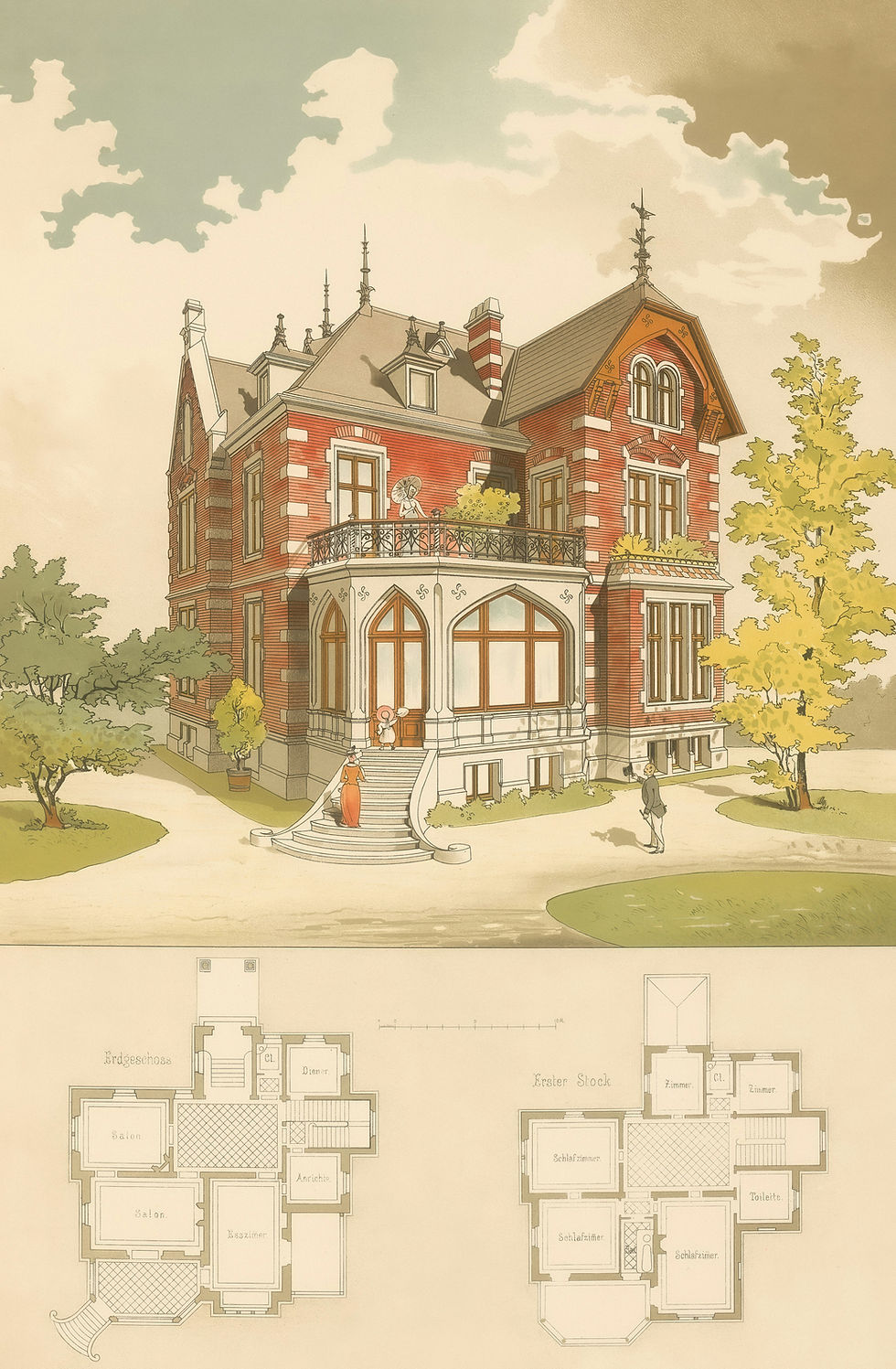
Imagine stepping into an old Victorian home up for resale. It has been modernized into a series of offices for a prominent insurance agency who is now moving out of town. The Gothic aura is instantly lost once you enter the hallway, for the hardwoods have been painted, the heart pine floors have been smothered in burnt-orange shag carpet, and the original lath walls have been paneled. As if that is not depressing enough, the grand staircase has been walled up, the massive sliding pocket doors have been removed, the gib windows have been replaced, and even the plaster ceilings have been lowered and tiled. With despair, you creak--for you can hear the old floorboards calling out to you--to the back entryway to find one old exposed brick wall. You buy the house knowing the old bones are still there, and you are about to rescue a masterpiece from a very bad and very dated "renovation."
~
Ideas, like old houses, not only change with time; they often undergo severe and completely inappropriate renovation. We have lived in a culture embedded for the past 100 years in the idea of a pre-tribulation Rapture. The idea has been so deeply ingrained into our psyche that examining it has become taboo--so much so that daring to verify evidence of it in Scripture is tantamount to speaking heresy. Clearly, we are not to remodel Scripture. But what we have not been told is that the pre-tribulation Rapture is itself the renovation of an understanding of the Rapture that spans 1800 years of church history. Furthermore, this renovation hasn't taken 200 years to surface; it sustained direct and fierce opposition from the moment John Nelson Darby broke out his new ideas in 1830.
Despite the pre-tribulationist claim that the teaching of the Rapture is under more attack now than ever, that statement is not historically defensible. Not only did the very greatest Bible scholars attack this novelty in its own day; all of them still believed in the Rapture as inseparable from the Second Coming of Christ. It is a fair question, therefore, to ask first of all if this pre-tribulation Rapture idea is indeed a renovation, and, second, if it is, why the church today has mistaken the renovation for the original Victorian mansion.
~
A trained eye knows that the renovation violates not only the original blueprints of apocalyptic prophecy but also logic itself. The elephant in the room is the sheer lack of explicit wording that identifies a seven-year gap between Christ's "appearing" and His Coming or that forces us to believe that an extremely loud trumpet signaling millions of dead believers being raised is somehow "secret" or that Christ could appear without appearing--for every eye will indeed not see Him if His Coming for the Church is secret. Also unexplainable is the unquestioned belief that the Rapture remains imminent, despite all the timelines that have come and gone for its being "just around the corner." Pre-tribulation Rapture eschatologists have to keep finding new explanations for why Christ has not yet come--for He was supposed to come during the likes of Hitler--which, in itself, warrants its own separate study as one of the greatest travesties ever told of Christians dropping the ball to help those in need.
When we are talking about renovation, we need to be clear that the changes are far more serious than carpet on wood floors. Entire load-bearing walls have been removed, making the renovated structure itself too heavy for its own weight. How do we justify dismissing the very passages Christ gave us outlining the signs of the end of the age by saying they were all written for the Jews? Dare anyone shout down such arrogance and stand up to this horrible hacking up of truth to say that every word of Jesus Christ has been spoken with binding authority for us today? Not only are the teachings of Christ a load-bearing wall that has been removed; all of the passages dovetailing the first resurrection with the last trumpet have been shuffled so that "first" means "second" and "last" means "first." Even Christ's Second Coming becomes His "third."
These are high-handed renovations indeed, for if we start changing the meanings of words, nothing means anything. And the demolition fallout is toxic to true textual analysis. Rerouting the Rapture from its timing with the Second Coming of Christ has required re-inserting it into a few cryptic clues. The angel's direction to John to "Come up here" becomes a secret summons for the Rapture. The elders (presbyteros) undergo an unprecedented transformation into the raptured Church singing around the throne. But why should we dismiss incontrovertible evidence and embrace the wispiest of clues? This very mindset breeds the strangest doublethink: a vague misgiving that resorts to dogma. In reality, all this hunting for pre-tribulation Rapture clues in passages that aren't even about the Rapture assumes that Christ is being elusive. But if He is explicit about the timeline for His Coming, why wouldn't He also be explicit about a Rapture seven years earlier? Why would He expect us to await a secret Rapture that is so secret we can't even find definitive evidence for it in the text?
~
The Architect always leaves evidence of His fingerprints. Truth is objective, not subjective; and, although the Holy Spirit has promised to guide us into all truth, we also know that no Scripture is of private interpretation. Truth is rugged and it is durable; it isn't going to crumble under analysis. On the contrary, the closest scrutiny will find an astounding consistency in Scriptural DNA, such that deep study of the Greek vocabulary, syntax, and context of all the favorite passages claimed to support the pre-tribulation Rapture will either hold up or fall apart under the microscope.
It must be pointed out that this process is anything but arbitrary but honors the way the Lord created our minds with the ability to read. When we apply critical reading strategies, we see that the building blocks of reading must fit: vocabulary must fit with grammar and syntax; syntax must fit with surrounding text; author's purpose must shape context. Context must honor history. Honest reading comes with a humble mind and a clean slate. This process is the very soul of exegesis. Whatever is true is what we determine to find. Our strategies are these: determining the main idea of the text; reading for detail (including basic and secondary meanings of Greek words); rereading; questioning the text; making inferences; using chronology; determining cause and effect; making predictions; comparing and contrasting; making generalizations; summarizing; and evaluating.
Critical reading strategies follow a logical sequence, confirmed upon repetition--even though they typically occur cognitively in random order with spiraling and looping until comprehension is reached. I have to conduct a first read in order to determine the main idea, but I have to reread or close read--this time, reading for detail--to checkmate the main idea I think I have found. Questioning the text involves rereading and refining the main idea even further. Subsequent to this process of spiraling and looping, I begin to make generalizations--but the soundness of my generalizations depends upon my ability to determine cause and effect. But I cannot determine cause and effect unless I pay strict attention both to the chronology of events and to the order of ideas within the text. It all matters. The process snowballs but also resolves into deep comprehension.
What we often see is a distortion of this process: forming generalizations apart from textual details (also known as textual evidence); determining cause and effect while ignoring chronology; making inferences without questioning the text. Many readers--perhaps most--do not follow the critical reading process in its full logical progression--and walk away, therefore, with a misread without even knowing it. This is especially true with a complex text such as the Bible. Thus, the lure of countless readymade shortcuts that analyze the text for us. But not only should we push these shortcuts aside; we should even set aside our own previous study to keep comprehension fresh. This is work, and grit is the secret ingredient to full comprehension. Honest effort honors the Lord. He will not bypass the way He created our minds to drop upon us epiphanous bursts of inspiration that cannot be defended on the page. His Word is logical even in its being supernatural, and the logic inherent in good reading must respect His craft to avoid a misread.
~
A straightforward look at the critical reading process uncovers some uncomfortable realizations: not only does our culture not do this; even many so-called Bible "experts" do not do this. Many popular teachers merely quote each other or their mentors from the past. Or they stand on their shoulders while reaching for esoteric "evidence" that no one can prove wrong. They come to the text with a "sacred" eisegesis to which they remain viciously loyal. The eisegesis in itself prevents honest exegesis because the stakes are too high: popular teachers cannot admit to their fan club that they are wrong. They rest in the appeal to authority, such that an astonishing degree of confirmation bias and blind regurgitation explains how renovations of Scripture survive as long as they do.
Not only do teachings of eisegesis survive because of image protection; they self-perpetuate because of emotional insulation. When a popular teaching awakens a primal emotion--such as hope or fear--across a massive audience, pathos replaces logos, and the result is not unlike that produced by propaganda. To be sure, the creeds of the Christian faith are hard-earned in corporate checks and balances across the centuries, but when renovations of historic teachings garner greater loyalty than does time-tested truth, something other than honest exegesis is going on. The result is both toxic and tragic, but the day of being spoon-fed someone else's dogma is over.
So it comes to this: we cannot afford to believe an idea only because we are afraid of being labeled a heretic if we don't believe it. If an idea is true, the blueprint will reveal it every time. If it isn't, it's time to restore the original mansion that has been wrongfully renovated.
~
If the pre-tribulation Rapture is true, we ought to be able to find it in Scripture. This is not asking too much. I believe with all my heart that we must come to the Book of Revelation believing by logic alone--as guided by the Holy Spirit--that Christ did indeed reveal in the Book of Revelation exactly what we need to know before time ends and eternity begins. This isn't a game of Clue. I believe the actions that describe the event are, in fact, the event. I do not feel entitled to knock out this load-bearing wall.


I have done several studies on this book. It seems once you feel a certain way in how it's taught to you, you cling to that.
I pray for answers and clarity, but I'm grateful my body, mind, and spirit is ready for Jesus to return 🙏