Philadelphia: The Future Church
Updated: May 5
Introduction
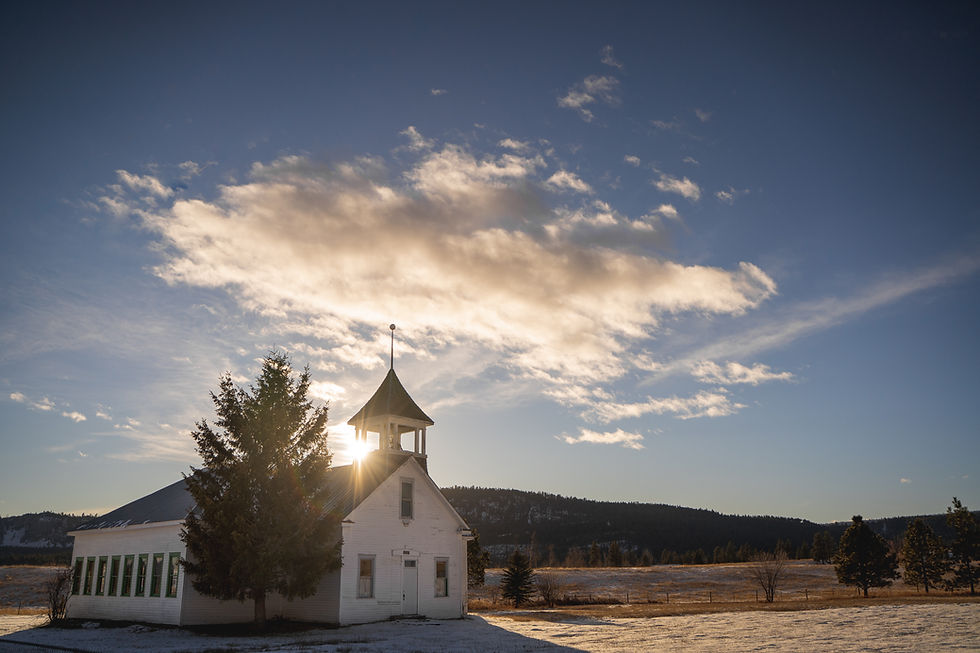
What a breath of fresh air this little church is amid a sea of corruption claiming to be the Bride of Christ! If your church is tiny but alive, this is one of the rarest blessings you will find this side of heaven. What makes your church alive? Everything that our Lord Jesus did not find in the churches He lovingly chastised in first-century Asia: unconditional love and devotion to Christ Himself; love for and fidelity to the teaching of God's Word; and love to others that manifests in holy and sacrificial living. Alive churches aren't perfect, but they are whole. They offer a full meal to hungry souls. They bring a cup of cold water to thirsty spirits. Such was the Church at Philadelphia. Often characterized as the "faithful" church, the Church at Philadelphia might well be called The Future Church. This church is the spotless Bride ready to be adorned for her Husband; this church is the church of heaven on earth, where we will worship for all eternity.
The Open Door
Notice what immediately sets this church apart from all the others we have seen so far: "an open door" (Revelation 3:8). Even Smyrna--the only other church among the seven that meets no censure--is warned that some of its members will be cast into prison (Revelation 2:10). But what does this open door mean here? It would not stretch the imagination to realize that the door Christ holds open for this little church symbolizes its entire ethos: an open door is exactly what every church should have for anyone who needs to stumble inside. Like a mission in a heartless city or a city on a hill, a church with an open door is the only church that is truly "inclusive" in a way that honors Christ. The dirty will not be shamed; the thirsty will not be poisoned; the hungry will be filled. But, above all, the sin-filled will be confronted with Truth.
What is the open door that Christ holds for this future-filled church? Certainly, an open door symbolizes opportunity despite obstructions, but how can we miss the deeper truth that Christ is Himself the Door (John 10:7,9)? When Christ alone is preached as the Way, the Truth, and the Life, the future-filled church holds the Door open week after week for as many souls as will enter therein. If only all seven churches of Asia had been characterized by this open door! Tragically, there is not an open door to many churches today, despite huge crowds: if Christ is truly preached at all, He is but one archway of many.
We cannot forget the rich symbolism of doors throughout Scripture--such as the blood required on the doorposts in Egypt on the night of the Passover. Although Christ was the Door then barring the Death Angel from striking, the blood spatters formed a Cross through which whosoever will may enter into salvation today. We also think of Isaiah, whose vision of God during the year King Uzziah died not only "opened" his mind to eternity but literally moved the doorposts of the Temple with angelic cries of "Holy, Holy, Holy" (Isaiah 6:4). As the very pillars of the Temple trembled with God's holiness, this open door proved God's holiness a barrier to all that defiles. Only Jesus could move this barrier.
And yet to this awe-filled place He draws His own. Think of those humble, beloved words of Psalm 84:10, "For a day in thy courts is better than a thousand. I had rather be a doorkeeper in the house of my God, than to dwell in the tents of wickedness." Being on the right side of the door is what matters! "For the LORD God is a sun and shield: the LORD will give grace and glory: no good thing will he withhold from them that walk uprightly" (Psalm 84:11). Doesn't this sound like an open door to you?
The Key of David
Even before Christ makes this eloquent promise of the open door to the Church of Philadelphia, He identifies Himself as "he that hath the key of David, he that openeth, and no man shutteth; and shutteth, and no man openeth" (Revelation 3:7). David was anointed by God as the king of Israel long before he sat upon the throne, as Christ Himself has long awaited His rightful place as King over the kingdoms of this world. But what is the key? It is Christ's authority over evil. Notice that a key not only unlocks but also locks. Wouldn't you want to know that you were locked in if you were Noah on the ark? And this is exactly what the Lord did--He shut him in (Genesis 7:16) against the wrath of God poured out on an evil world. Although the Lord did not shut David in, He protected him from evil wherever he went.
When Christ holds the keys, no one can enter our circle of safety, and no one can block our effectiveness for the Lord. No one, not even the Antichrist. Notice this church's direct link to a Tribulation promise: "Because thou hast kept the word of my patience, I also will keep thee from the hour of temptation, which shall come upon all the world, to try them that dwell upon the earth" (Revelation 3:10). From the sheer fact that the Great Tribulation has not yet happened, we know that this little church has not outlived its open-door promise. Every little church--or big church that feels little--has descended from the DNA of this faithful church that not even the gates of hell itself can stop (Matthew 16:18). And the fact that the Great Tribulation looms ahead should not shake the confidence of this church. The door against evil is paradoxically locked even when it appears to stand open.
We see this phenomenon of divine protection in the land of Goshen when God's chosen people did not experience the last seven plagues of Egypt. God made a difference for His own. We also see this protection promised in Psalm 91. Despite witnessing evil on every hand, those who live under the Shadow of the Almighty can claim these precious words, "but it shall not come nigh thee" (Psalm 91:7). Although Satan took this Psalm out of context when he tempted Christ, misapplying this promise: "For he shall give his angels charge over thee, to keep thee in all thy ways" (Psalm 91:11), this protection is guaranteed in a way Satan in his lostness cannot comprehend. The keeping power lies not with the angels but with Christ Himself. Satan thus made a fool of himself in missing Who holds the "key" of David for all believers.
What is indeed the "key" to escaping evil? Is it not to be kept in the Presence of the Almighty? And how are we "kept" unless we "abide"? If we compare the Hebrew word for "keep" in Psalm 91:11--shamar--with the Greek word for "keep" in Revelation 3:10--tereo--we may make a fascinating connection that may also serve as a necessary correction to the popular misconceptions surrounding the promise for the Church at Philadelphia. Is this church promised a Pre-tribulation Rapture? Yes, if escape is the only way to be "kept" amid danger. And yet the fact that the Church at Philadelphia received this promise of protection during their present trials without being raptured forces us to conclude that the promise did not necessitate physical removal from the "hour of trial." It does not promise being "kept" in any location other than in the Presence of God.
Everything hinges upon God's power to keep me in the midst of danger. And this "keeping" does not necessitate taking me out of it, any more than it did for Shadrach, Meshach, and Abednego in the fiery furnace or for Daniel in the lion's den or for Noah in the ark. When we grasp the image created by the Hebrew word shamar in Psalm 91:11, we see that this root links with shamiyr, an actual hedge of thorns constructed by ancient shepherds to keep predators out of the sheepfold. This Hedge is the same as the Shekinah glory that protected the children of Israel with a pillar of cloud by day and a pillar of fire by night for forty years in the wilderness. The same Lord who is Himself the Door is also the Key--and this "key" to preservation from all evil is His Presence: "And, lo, I am with you alway, even unto the end of the world" (Matthew 28:20).
If the Hebrew word shamar in Psalm 91:11 implies being kept in a hedge from wolves, it also assumes that the wolves are present. Similarly, the Greek word tereo in Revelation 3:10, which means "to guard or protect by keeping the eye upon," assumes that there is something I need to be guarded from. Neither shamar nor tereo necessitates physical escape in being "kept" by God; on the contrary, both actually imply the opposite: an actual present danger to be shielded from. Because both words show a far deeper protection--God's Presence as impenetrable to our one real foe, Satan--even death is not the enemy. As kept by God's Presence, we are the apple of His eye (Zechariah 2:8)--kept, as it were, in the eye of the storm. We not only enjoy His guidance (Psalm 32:8); we employ His surveillance: His eyes run to and fro throughout the whole earth "to show himself strong in the behalf of them whose heart is perfect toward him" (2 Chronicles 16:9). The hedge of the Lord--His keeping power--is both the open door and the locked door to which He alone holds the key.
Christians have debated for the last nearly two centuries a question that the Church in the 1800 years prior did not seem to ask: whether or not Christians would go through the Tribulation. We cannot answer that question here, but what we can do is to say that it should not matter. We are as safe here on earth in the Presence of the Lord as we would ever be in heaven.
The Pillar in the Temple
Without being dogmatic, there is reason to wonder if the promise given to the Church of Philadelphia, rather than guaranteeing a Pre-tribulation Rapture, actually foreshadows deliverance to those Israelites who refuse the Mark of the Beast but who are not yet converted to Christ until His feet touch the Mount of Olives. If this group is the nation "saved in a day" (Isaiah 66:8), they will indeed be preserved from physical danger--as were Noah in the ark and the Israelites in Goshen--during the Tribulation and even during the Day of the Lord. For if they were not, who indeed would still be alive in their mortal bodies to enter the millennial reign of Christ? And are not God's chosen people the pillars upon which His earthly kingdom rests? Although we could not call this group a "church" while they remain unconverted, the point is this: Christ will indeed divinely protect His children who remain on earth until He comes.
What is also clear is that the Church at Philadelphia--that did indeed retain its identity and that rested on a site that remains strong to this day, unlike the churches of Pergamum, Thyatira, or Sardis--still has an open door working as a through-line from the first century to the bodily return of Christ. And what is that, we may ask? This surviving "pillar" could accurately represent any member of Christ's Body who has kept his or her lamp trimmed and burning amid spiritual darkness and who withstands the persecution of false Jews (Revelation 3:9), no matter what little strength is left. Strength that feels strong isn't strength; strength that feels like weakness requires endurance. Endurance--and not escape--is the theme of Revelation. The same Lord who said, "He that is faithful in that which is least is faithful also in much" (Luke 16:10) will see to it that the faithful will indeed receive much in His kingdom. The two-talented man will receive a double reward exactly as the five-talented man.
But even here we have a sobering word: "Behold, I come quickly: hold that fast which thou hast, that no man take thy crown" (Revelation 3:11). Take thy crown? Is this possible? I thought this church was good to go. But the open door Christ places before this church requires one thing: that they walk through it. To hold fast is to continue in the way we are already traveling. "I am the way, the truth, and the life: no man cometh unto the Father, but by me" (John 14:6). Perhaps every church risks allowing its open door to become a broad road. But those who hold fast will receive not only "doorkeeper" status; they will be made "a pillar in the temple of my God, and he shall go no more out" (Revelation 3:12) but "will dwell in the house of the Lord for ever" (Psalm 23:6). And then this: "And I will write upon him the name of my God, and the name of the city of my God, which is new Jerusalem, which cometh down out of heaven from my God: and I will write upon him my new name" (Revelation 3:12).
Conclusion
Why is the Church of Philadelphia the future church? Do they have entitled status? Christ is never arbitrary. If He were, He could have spared Himself the standard greeting to every church: "I know thy works" (Revelation 3:8). "Thy works"? We are so worried about "works salvation" these days that we scarcely know "salvation." If only we were as focused on our works as Christ is to every church of Asia! "These things saith he that is holy, he that is true" (Revelation 3:7). God who cannot lie will not call a corrupt church "saved"; neither will He call a little church a lost cause. He sees that church with a "little strength," and He multiplies that strength with His strength (2 Corinthians 12:10).
What accounts for this "little strength" for the Church of Philadelphia, battling "the synagogue of Satan" (Revelation 3:9)? The secret to this church's future is to keep "my word" and not deny "my name" even amid Tribulation. The name Philadelphians will not deny is the name Christ will write on them forever. Is there any future better than that?


Very good presentation of Revelation and the church of Philadelphia. God bless you, Melanie